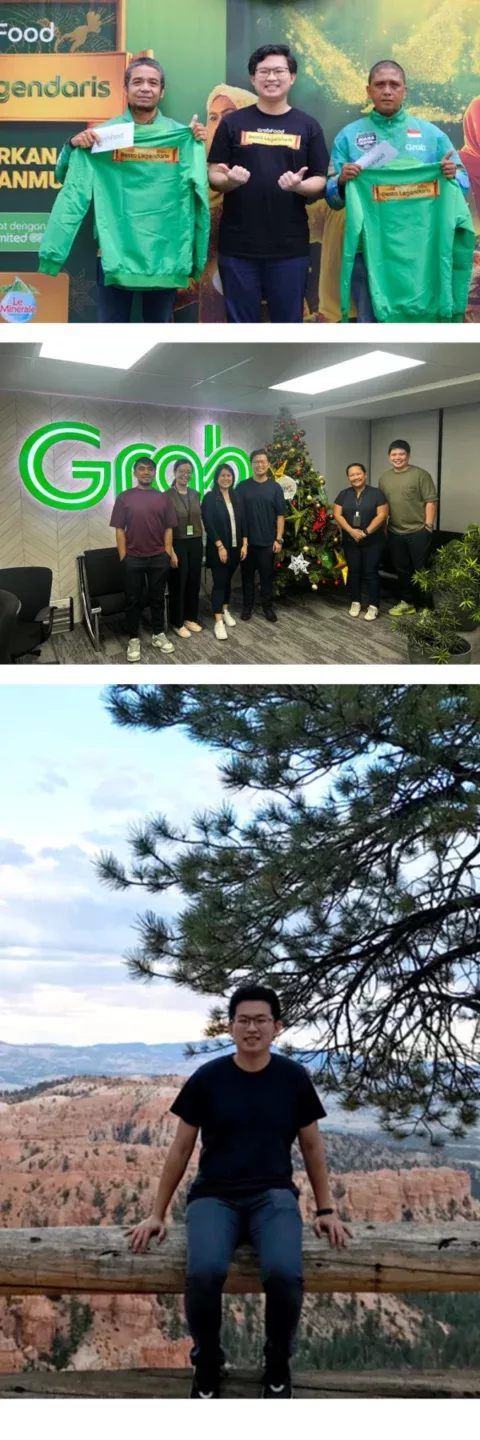
Mr. Ivan William
Bachelor of Economics, 2016
Head of Commercial, Grab Indonesia
Ivan shares his career journey, from his pre-university days, to getting into banking, then to entrepreneurship, and finally to his current position at Grab. He shares some of his basic tenets that have helped shape his approach to his career path, which he adopted even while during university. His current position as Head of Commercial, Grab Indonesia, is a result of this approach. Thanks again to Dee for arranging this conversation.
So! I guess we can start by setting the scene – can you give us a brief introduction to yourself, what you’re doing now, and where you’re based?
So, my name is Ivan William, you can call me Ivan. I’m currently the Head of Commercial for Grab, including Grab Food, Grab Mart, and also Grab for Business.
So those are the three verticals that I’m in charge of, and I cover regions outside of Jakarta – we call it “ex-Jakarta” region. In other words, anything that’s not Jakarta, I’m responsible for.
This includes dealing with merchants, i.e. restaurants that want to sell with us; supermarkets and other sellers of non-food items like OTC medicines or souvenirs that want to partner with GrabMart – for instance, if you go to Bali or Medan, you can buy souvenirs from GrabMart!
And in addition, I have additional responsibility for Grab for Business, which includes covering corporate clients that use Grab as a kind of corporate benefit for their employees. For example, when employees go to meet clients, they can use Grab. When companies arrange events, they may need catering, and they can arrange this via GrabForBusiness, and get the food delivered through Grab. So, we coordinate on both the merchant side and also the client side, for Grab For Business.
Sounds like a lot of possibilities! You’re based in Jakarta now?
Yes indeed, I’m based in Jakarta as that is where our head office is (for the region). Before I had my daughter, however, I did travel every two weeks. For example, I would go all around Sumatra Island area, covering cities big and small. Now, it’s a bit more difficult, but I still have to travel about quite a bit – I spent the whole of June visiting the different cities that I cover. And last month too. Wait, and in August…
That seems to be pretty intense, considering Indonesia is also…quite big?
Yes indeed (laughs). Indonesia is huge!
(Laughs also) Let’s rewind a bit – back to before university…Grab wasn’t even around then, so things were very different. I imagine the original thinking behind your career trajectory may also have been…very different?
So even before HKU, I was influenced by the people around me. I actually did my high school in Singapore, so it’s similar to Hong Kong in that everyone thought about getting into (banking, finance, consulting), those kinds of jobs. And I was actually interested in Economics, so I did want to take it. So, finance, banking, did make sense.
At the time, the best place for banking was probably Hong Kong, and China was also growing so quickly, much faster than now. So that’s why I decided to go to Hong Kong, to follow the trend of going to HKU, taking Economics and Finance, and going to banking.
So, were your parents in banking as well? How did you come to be in Singapore?
So, my parents, like many Chinese Indonesians, were actually entrepreneurs – they had their own businesses.
As for Singapore, I had most of my education until Secondary Three in Indonesia, in my hometown of Medan. The Singapore government has a scholarship for top students – we had to take tests for math and English to qualify. I managed to get in! But I had to repeat Secondary Three, as a condition to sync up with the English curriculum in Singapore, as most of my previous schooling was in Bahasa. So, I repeated that, did Cambridge O-Level, did IB in the same school, graduated, and then went to Hong Kong.
Did you guys speak Chinese at home?
Yeah, I think in Medan, we still preserve some of the Chinese culture – we celebrate CNY, Qing Ming. I can speak Mandarin and Hokkien.
I see. So, it seems like your path was pretty set, and HKU was probably a great destination for you. How did you begin pursuing your career dreams?
Actually, after my first year, I was basically done aiming to be a top student. Being at HKU, it was kind of like a soul-searching period. By the second semester in my first year, I wanted to explore a bit more and not…get caught up in the grind, I guess. Perhaps there’s a better way to phrase it! But anyhow, I began to focus more on things that I wanted to do. I was actually working with Dee (see previous interview here) for the HKU Service 100 project, and I put a lot of effort into it.
What pushed you in this direction? What changed for you?
I wouldn’t say something big happened, I would just say that…I was done with studying. Maybe…at the time, HKU was promoting various extracurriculars, and this opportunity caught my eye. It was a chance to try entrepreneurship in a way. I mean, it was about organisational skills, fundraising, prepare a proposal, etc for Cedars Service 100. And the spirit of helping and making an impact, that really motivated me.
So, in that second semester, and then into my second year, I was almost completely focused on this. My GPA was so bad.
(Laughs) But in terms of internships?
I didn’t do any of that.
Oh, actually – one thing that I realised was that, not being local to Hong Kong, I really needed to expand my network. So, I socialised a lot, like, hanging around Chi Wah Learning Commons, hanging out with friends, etc. And they had friends who were local, or were international school locals, and then they had their friends too, and they would introduce them…it kind of snowballed. We would go out for meals, explore Hong Kong together…I was also involved in HKUSU Golden Z Jong * as well.
So, I was doing local things, exploration outside of studies…really a more adventurous sort of student life.
*Jong – executive committee of society’s/halls/clubs/student associations/other.
But surely you must have considered a career at some point, right?
Sure, sure. I did do the HSBC co-op trainee programme. That’s really the next part of the story. My GPA at the time was so bad, I honestly thought I would not be able to get a job if I graduated in the three-year programme. So, I decided to find an internship and delay graduation, in order to have a fallback plan.
I think I was quite lucky to get it, because I got a job that I needed – it was a one-year experience that was also paid. I wouldn’t say it was hard, but I really was fortunate that it was a good learning opportunity. I also had a good boss. It was a great grounding in how corporate life works.
What sort of role was it?
It was a corporate banking middle office role. I was basically in charge of certain functions and was fortunate enough to not be responsible for getting coffee, but to get real responsibilities. I was directly supporting a manager, so I was lucky that my boss at the time was so supportive.
At the time, one of the interesting projects I worked on was to work with the HSBC Head of Exit (i.e. the team head who was responsible for the function that helped customers close their accounts) in streamlining flow. I had the capability of knowing how to learn and use Microsoft SharePoint, hone my Excel skills, and also had the capacity to help manage the process for exit.
So how influential was this experience for you?
It definitely helped. I would say this got me my job at Standard Chartered, as I didn’t submit my GPA in my application for that role. The HR was shocked when I shared my results after I got in!
(Laughs) what I mean is, after you did your internship at HSBC, you were in your final year. So, what was your plan at that point?
I think…I still hadn’t really tried banking, but I knew that I didn’t want to be in Hong Kong. I think the language barrier was a major factor, but there was also a significant pull factor for me personally, for being in Indonesia.
At the time, there was a significant change in the government, and things were very positive. So, I wanted to try something back in Indonesia, though I didn’t know what. So, I just applied to anything. And Standard Chartered was one of the jobs that was a fit for what I needed – a global job. The International Graduate Programme gave me the chance to work in Indonesia, while also having an option to work in Singapore, or even elsewhere, after the programme ended, depending on availability of roles of course. It was a great programme – I had training in Shanghai for a month, did CFA level 1 as part of the programme, rotated into Singapore to do Shipping Finance for a few months, and even tried investment banking.
However, when I finished the programme in 2017, the job market was going downhill. I had wanted to try Singapore, but it wasn’t to be. So, I stayed on for a role in Jakarta.
I guess that was your first graduate job. How did you find it? What were some of the challenges you faced?
There was definitely a lot of learning done. The biggest learning curve was actually with HSBC, learning how to be disciplined and make the 9-5, and maintain a proper schedule as opposed to university. Then there’s also communication skills with various stakeholders – learning how to manage, provide regular updates, basic stuff like that. That’s the foundation I learnt at HSBC.
So, when I was in Standard Chartered, the corporate fundamentals were already in-built. I was enjoying learning more industry knowledge, understanding the banking business, and gaining more skills.
I was in the operations, the credit team as an analyst. So, it was not a client-facing role. But the job, on top of all the training provided, such as the Shanghai training experience, really helped me build that basic banking knowledge.
So how come you left banking?
Very honestly, the industry culture was pretty rigid. I remember in my first performance review, which was about three months in, I had thought I was doing a pretty decent job. Credit analysis at the junior level is about reviewing clients on a periodic basis, to assess whether the bank should continue lending to the clients. That’s what the job is about, in its simplest form. But in my performance review, I found that I wasn’t getting direct feedback on my actual job performance, nor on metrics that I think were relevant to my growth, which I found disappointing.
I was also considering starting a business. I guess it harks back to my idealist days as an HKU student! I think my background was definitely a factor. Besides, Indonesia is a huge market too, with a large addressable customer base. It was also pretty vibrant at the time – looking back now, over the past 10 years, you can see so many new startups in the market that have proven themselves since, it’s really growing quite rapidly.
Having been educated in Singapore and Hong Kong, I was kind of put on the path to a corporate job. But after my experience, I put a pause on that sort of lifestyle for now.
Coincidentally, my brother, who had been working in Taiwan, had also resigned, while my youngest brother, graduated in Taiwan also. We could all see that, at that time, coffee culture in Indonesia was taking off – it’s crazy now right. So, we had a small family discussion, decided we’d try to get onto this trend, and started Summa Coffee.
Oh wow, so your entrepreneurship dreams began!
Yes, we started it in our hometown (Medan). I would say we were equal partners for this, though as the eldest brother, I was the de facto General Manager. So, I managed the strategy and direction. Meanwhile the second brother was the roaster, relying on his engineering background, and was doing sales as well – it’s all related after all, as we were doing B2B, selling to cafes that didn’t roast beans themselves. And at the time, there were very few roasteries as well.
So yeah, it was a pretty scrappy, young, entrepreneurial kind of style. We would visit cafes that were opening, or existing cafes, and would try to see whether they would need a new supplier or something.
Finally, we eventually found our first customer, I guess they maybe took pity on my brother, so they decided to take a chance on us. And from there we got them as our first customer.
For the company, it sounds like a quick ramp up, from idea to execution.
Yeah, we were really like, “let’s do it”. I mean, right away we went to farms and tried to source coffee in the mountainous areas near our town 2 months after we had the initial discussion.
Wow…so how do you think your startup went?
I think…we were all inexperienced, so it took a long time to ramp up. Perhaps a year, maybe, to get this thing up and running. And of course, there were a lot of disagreements as well. I mean, we’re siblings, so it was kind of normal.
Anyhow, it took a year to understand how things were done, like getting consistent repeat clients, and then getting enough clients for the business to run. We can’t even talk about a return on investment yet. This was just to keep operating and have a good number of customers.
After the first year, I think we wanted to experiment a bit more. So, we did an exhibition as well. Although we started as B2B, we also wanted to explore B2C as well. So, we did this exhibition in Jakarta and Surabaya, which are the two biggest cities in Indonesia. We were applying for things like startup incubators, attending exhibitions in Surabaya, and also a food exhibition in Jakarta. We would also do demos at the exhibition, to show people how to brew coffee, let people taste our coffee, things like that. So, we were just doing random things to see what direction the business could take to expand out of our hometown.
So then, what sort of niche, or edge or audience did you manage to discover, that could push your business forward?
For us, I think…well, it’s not a business that has a high barrier to entry. It’s easy for people to buy a small roasting machine and get into the game.
So, for us, we were focused on B2B service – coffee is just one small part of the business usually. If you’re not a roaster, you would usually have a range of things, food for example.
So, what we offered was a good stock management system. We focused firstly on taste profile suitability – we would customize whatever the customer wanted. We were more flexible than others that provided a similar sort of solution, particularly in terms of pricing and tastes that we could offer.
Second is the B2B service – we would track closely the usage and business style of the client, and what they would order, their report order, and other such patterns. We would then start to advise them on their order sizes and frequency. A lot of customers didn’t have such a sophisticated stock management system, so we created value by tracking their stock for them and supplying them with the right amount at the right frequency. We learnt to create this proposition, based on this problem, quite early on. It was very manual in the beginning, having to track orders, sending customers reminders when it was about the time when they usually ordered. Eventually, we got the formula right, and customers could just confirm deliveries, so it was more convenient for them. I suppose this second thing was critical, as no other people in the coffee business in Medan was doing this at the time.
The business is still running now, but as I’ve since left for Grab, I’m only a shareholder/advisor. My current knowledge has been quite helpful though – for instance my brother pivoted and opened a cafe in another city. My knowledge of the market through Grab actually allowed me to gain an insight of the market there and know that it is underserved. So, my brother is working with another partner after I left, to grow the business in that city. It’s doing well!
Hopefully you got your return on investment! So, you were living the entrepreneur dream…why join Grab?
Everything is luck really. I think many people would say that. First year of doing the startup, I guess…the thought that I was an HKU graduate, making about minimum wage of HKD1,500 at a family business…sometimes I really questioned myself. What the heck was I doing?
However, after the first year, I stopped questioning myself and committed to focusing on the business. But sometimes, when that happens, opportunities come to lure you away! I was headhunted on LinkedIn!
I didn’t think much of it at the time, I attended mainly for interview practice, not necessarily to get the job. Grab was a growing startup at the time, so I was also curious how they conducted interviews. Grab had entered the Indonesia market about 2016-2017, so they had been there two to three years at the time I interviewed. They weren’t huge then, but people were starting to use their platform.
So, I did the interview, did well…I think they liked my experience in banking and finance, which demonstrated my financial and analytical skills. Secondly, the role was business operations for Grab Food. I would have had to deal with getting more merchants to get into GrabFood, which is exactly what I was doing with Summa Coffee, where my clients were merchants. So, I already understood how F&B works! In GrabFood, it’s similar, just a different product. How you approach merchants is the same – you need to understand the F&B scene of the city, get to know the merchant owners, expand your network, etc. This experience really helped me get my first job at Grab.
I see! So perhaps, we can hear more about your progression through Grab since? How have you found your move to management too?
I would say three things. The first, the role was something like a senior associate. I had to deal with execution and operations. And I was reporting to the General Manager of the local region – for the Indonesia market, we are separated into different major islands. My GM was in charge of Makassar, which was therefore the city I was assigned to. And then he resigned, so I had to report to the regional general, and he handled almost everything – the PNL, sales operations, everything for the Grab Food business.
So, for the first three months of the job, I had to really step up and support things like, managing sales, and on the PNL side as well, which I already had some knowledge about through my banking experience. So, after about nine months, I think I was just about qualified to become a junior General Manager. Again, it’s also a matter of luck. And so, between 2020-2023, I was growing as a General Manager, and continued to see an expansion in the geographical scope of my remit – starting from a small city, to managing two more cities, then to half an island, and within the next few months, the whole of Sumatra Island which would be about 10 big cities and a variety of smaller ones. This took me about 2-3 years in total.
So, the job itself, it covers everything. I can do localisation of campaigns, marketing, the way we do sales, how the app looks…I mean, not the UI/UX itself, but…for example, if a region is selling a specific item particularly well, let’s say fish balls. Then I can say that, seeing as fish balls are selling well in this region, let’s change some icons to allow for users to click into a broad selection of fish ball sellers. And then users can click into this on the app. So, I can customise the app in this way, to adapt to local situations. There was a lot of flexibility, room for experimentation. I was also responsible for the budget, which enabled me to make decisions, such as tapping more marketing resource to compete with another platform in a certain city. In essence, I was running my own business, but in corporate. It was really fun.
It sounds like it’s building on top of your entrepreneurial spirit. Do you plan on staying in corporate in this sort of gig? Or going back to your own business in the future?
I think that this is a question that I still haven’t really answered yet. For now, those two options are still open to me. I do have a deadline for making a decision though, which is when I reach thirty-five, which is in two years. I at least want to have an idea by then. Even if it’s a corporate job, like what I’m doing now, I would say that I’m doing ok. As long as I’m learning and making an impact.
Actually, going back to your question about management. Since the IPO, we’ve become far more structured from an organizational perspective. So much less like a startup. So now, my role is more specific, but I do handle an increasingly larger area, including West Indonesia last year, and now all of Indonesia ex-Jakarta.
The change to management was definitely a steep learning curve, because in the past, I had full control, with a few approvals required here and there. But now, there are more people across specific functions across the company, so I can’t just do whatever I want. It is more sustainable for the company however, as I can focus on what I should be doing.
Through this change, I’ve also had to learn stakeholder management, whether they’re more senior or more junior colleagues in another team. I’ve also learnt how to present myself better. Though I’ve still a lot to learn, I recognize that the stuff I say is more influential than before, so I can’t just spout things at random. So now I have to figure out what kind of message I would like to get across in a meeting, and how to frame it. I don’t mean over-curate things, but be more mindful of what I say, and how I say things, such as the tone, words, for example.
Did you train how to do so, or did you have to learn this by osmosis?
I think it’s a bit of both. Grab does provide training – I just did one on negotiation, conducted by some lawyers at our Singapore offices, two weeks ago, which was very good. But really, it’s half training/coaching, half observing. You have to be cognizant of the culture of the company, how people work with each other. You can’t just base everything on theory.
When you look back on your ~10 year-career, what advice or recommendations would you give for younger graduates today?
Reflecting on how I navigated my career path, and considering the advice my manager at HSBC gave me, I think you need to know what you don’t want. That’s what he told me. I think I really took that advice to heart in the first 3-5 years of my career, where I went crazy at university and disregarded my grades, then looked for internships (and managed to get in! Luckily.) and still did pursue banking. I also recommend trying to do well in whatever you pursue, to really make sure to know if you want that job or not. Because if you do it half-heartedly, you will never know.
When I wanted to explore business instead, I had the courage to do so, to take that jump in spite of insecurity for a year.
So I think, given all that I just mentioned, having the courage, trying different things you want to do, to get to know better what you want, and keeping a look out for other opportunities, not closing off possible opportunities that could be interesting…because I could have just said no to Grab too.
Actually, one more piece of advice – if you want to do something crazy, do it earlier. I wouldn’t say everyone can do everything, nor would I say that I’m special to get where I am now, it’s really a matter of luck. I keep mentioning luck across this conversation!
And finally, and I hate this word, but networking is pretty important. Or rather, getting to know more people from different backgrounds. That will give you a better sense of what avenues you can explore. Especially in university, it’s a test bed. Don’t treat it like “I’ll do university then I’ll go get a job”. University is the time to do different things and see what you want. That really helped me to navigate my career, seeing what options I had, trying different ones. Even going to things like career talks, NGO, volunteering, I actually checked HKU Cedars page weekly to try out random things, and I even met my now wife through doing this! This all helped to expand my network, and helped me get to know more people, and through that, my knowledge of how the world worked.
Sounds like everyone should try volunteering at CEDARS for sure. Thank you very much for making the time!
Ivan is currently Head of Commercial, Grab Indonesia, based in Jakarta, Indonesia. You can connect with Ivan here.