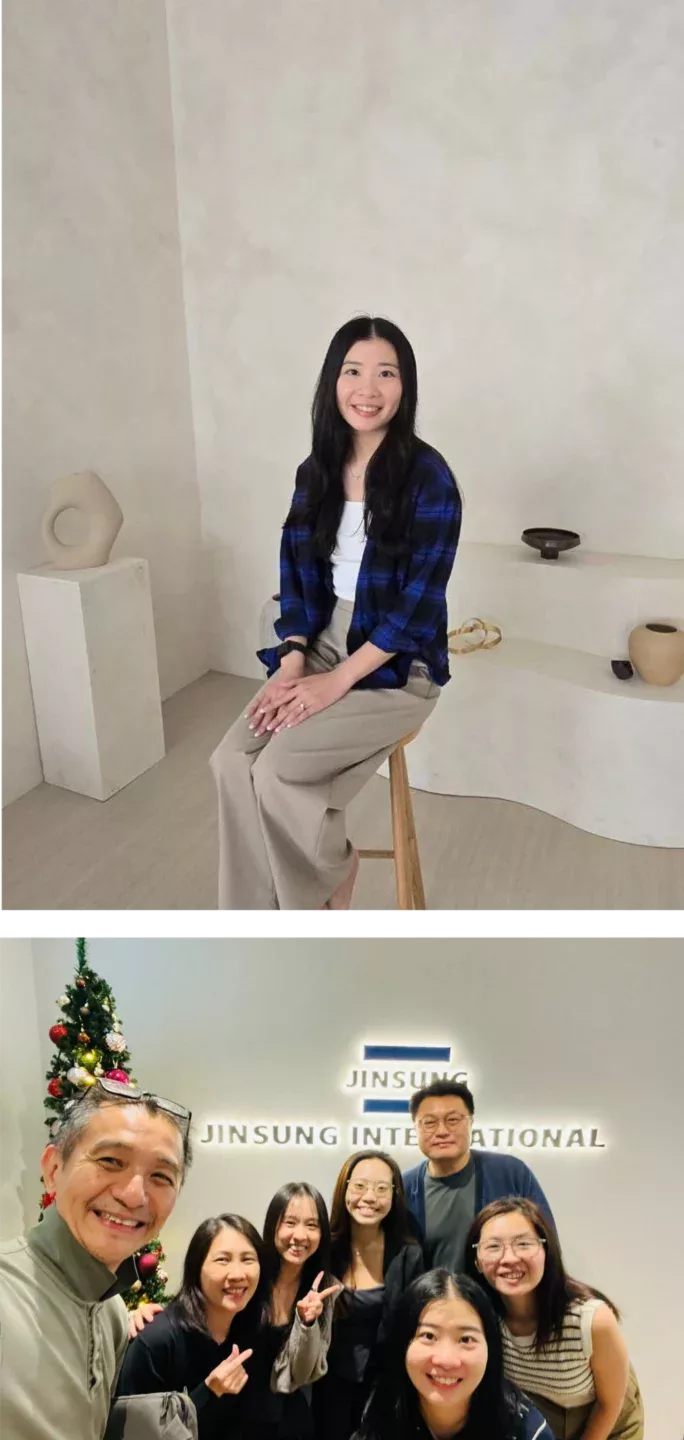
Ms. Ruth Yip
Head of Finance & Accounting at Jin Sung International
BBA Accounting & Finance, 2016
Ruth takes me through her career journey over different accounting functions at companies across several different industries, including Bridgestone Tyres, Panasonic, and Noel Gifts, before becoming Head of Finance & Accounting at Korean trading firm Jin Sung International. Our discussion makes for an interesting look at a career in accounting, the exposure across various functions within, and the approach that has helped Ruth arrive at her dream role as a Head of Finance.
Let’s start with an introduction. Tell us about yourself?
I’m Ruth, I graduated from HKU in 2016 with a Bachelors in Accounting and Finance. After graduating, I moved back to Singapore, where I’m originally from. Currently, I’m Head of Finance and Accounting at Jin Sung International, a Korean trading company. My career has spanned several multinational corporations and a Singapore listed company, and throughout that journey, I’ve been intentional about building a broad foundation across different finance functions to prepare myself for leadership.
How was growing up in Singapore like for you? How did you think about your career before you went to HKU?
I grew up in a supportive family environment. Both my parents are teachers, but they were never pushy about career choices. They trusted my sibling and me to pursue what we were interested in, and that gave me the freedom to explore my strengths.
My interest in accounting was partly influenced by my aunt, who is an accountant in the US. She really opened my eyes to this profession. I also genuinely enjoyed mathematics when I was younger, so I knew I wanted to work with numbers, though not necessarily in academia. Hence, pursuing accounting was something that came naturally to me. I’ve wanted to become an accountant since secondary school, and spent a lot of time trying to understand the accounting profession, so I have achieved my dream in that sense!
In Singapore, after you graduate high school, you get about a 8-9 month break where you can travel or try to get some work experience. During this time, I went to a construction firm to be an accounting executive. This experience really solidified my interest in the profession. It showed me what accounting work actually looked like day to day and confirmed that this was the path I wanted to pursue.
So what led to you choosing Hong Kong University?
Unlike universities in Singapore, HKU applications typically open a year before we actually enter, so I applied to HKU and received a conditional offer. When my A-level results were released almost a year later, I received offers from Singapore universities as well, and had several options to consider.
However, HKU stood out because it was the only university I applied to that offered a combined Accounting and Finance programme. Most Singapore universities offered accounting or finance separately. My manager at the construction firm I was working in strongly advised me that finance would be a valuable complement to accounting, and that advice stayed with me. Finance knowledge has indeed been very useful in my career, especially in roles involving treasury and strategic decision-making. And studying overseas was also an exciting opportunity.
So ultimately, the combination of programme structure, reputation, and the chance to study abroad led me to choose HKU.
How was your experience in Hong Kong, and of Hong Kong University?
Different from what I was expecting!
The school is definitely international, but there is still a noticeable divide between the international students and local students. It’s fortunate that I spoke a bit of Cantonese, otherwise it’s actually quite hard to mingle with the local students. During my stay, my Cantonese definitely improved a lot as I tried quite hard to speak Cantonese and make local friends, on top of the international friends that I made as well. This was also found in the classes too. Academically, most business classes were taught in English, but tutorial discussions often involved a mix of Cantonese and English. It was challenging at times, especially when concepts were discussed in a language I wasn’t fully fluent in, but it pushed me to adapt.
Socially and politically, it was an eye-opening experience. During my time there, issues such as national education and later Occupy Central were major topics. Coming from Singapore, where education and politics are typically more separate, it was a new experience to see students so actively involved in societal debates.
In terms of my professional development, I did quite a few internships in Hong Kong too. I did an audit internship during the summer of my third year, and continued to help with audit and bookkeeping into my fourth year, as I had cleared most of my courses by then. That really helped me in deciding that this was the type of career I wanted to pursue.
I do wish I had done more internships or had tried accounting or audit with different firms, just to get more exposure, or explore working in Hong Kong for a bit before moving back to Singapore. In the end though, I still wanted to move back to Singapore in the long term.
Are there any major differences in the working culture between the two cities?
In my experience working at an audit firm in Hong Kong, colleagues were generally more reserved. Many kept to themselves and brought their own lunches. In Singapore, I’ve found the working culture to be somewhat more social. Of course, this may vary by company, but I personally prefer environments where colleagues interact more openly.
What was it like, finding a job in Singapore as a Hong Kong University graduate?
It was fine – HKU is very reputable. Even though I graduated almost a decade ago, people still ask me about HKU. That’s one of the things that interviewers always ask – they are really curious about it, and it’s a school that people know. It definitely helped my profile stand out during CV screenings and interviews. Having an overseas degree also sparked curiosity and provided good conversation points.
Good to hear. Tell us a bit more about your first job back in Singapore?
I found a job as an executive at a Japanese tyre MNC called Bridgestone, and was responsible for accounts receivables – working closely with the sales team to collect payments and manage customer accounts. One of the main challenges was learning the soft skills to deal with customers. Sometimes I had to speak directly with customers to resolve outstanding payments, and I remember being scolded once for a mistake. It was a tough but valuable lesson in communication and professionalism.
At the same time, I was studying for my CPA, so balancing work, study, and personal commitments was challenging. The hours could be long, and I had to learn how to manage my energy and stay focused.
Any secret solutions?
Coffee definitely helped. I rely on my morning coffee, and occasionally another one if I know I’ll be working late. Another tip is to list out all the things that you need to do, so you can prioritise what the important tasks that day ought to be. Having a macro view of your work tasks is pretty helpful for staying focused. I also have Outlook Reminders on for the more important deadlines that I cannot miss.
So what came after Bridgestone?
I was at Bridgestone for two years, but wanted to move to a bigger team. Bridgestone is actually not that big, there were only four people in the accounting department! I wanted exposure to other finance functions because I knew that to become a Head of Finance one day, I would need a well-rounded foundation.
What sort of skills do you need?
There’s accounts receivables, which was my first job; accounts payables, which involves payments to suppliers, which I did for my second job; cash flow management; treasury management; reporting…so many different functions.
I believe I need to have a good enough foundation across these different roles. Only in this way, do I believe you have the ability to be able to manage these functions at a bigger picture level, as you have the knowledge of how these departments work.
I did manage to get some more exposure outside of Accounts Receivables at Bridgestone, but only as temporary cover.
And back to your earlier question, I left for Panasonic, another Japanese MNC.
How was that experience?
That was an Accounts Payable (AP) role. The exciting part of this role was budget management, which goes all the way to a product level, like washing machines, fridges…the AP person has to be the budget controller, and liaise with marketing, sales to make sure they do not exceed their yearly budget. I got to deal with so many different stakeholders, some of them way more senior than I was, and people from all kinds of backgrounds. This was especially as the Singapore office handled overseas offices and outsourced accountants as well.
The experience was very enriching in terms of the communication skills, management skills, and attention to detail required to reconcile budgeting and expenses across all these different parties. The manager I had at Panasonic is someone I really looked up to, because his skills were ones that I wished to learn from. He gave me a lot of guidance in terms of both hard and soft skills.
What were the main traits he had that made him a good manager?
He was protective of his team. Some bosses aren’t like that. Even when he didn’t necessarily agree with our line of thinking, he would always stand up for us. For accountants, sometimes the sales team may view us as just a support function, and may want us to do this or that to support sales. But accountants are really the gatekeepers of the company and need to ensure compliance and control is followed through. So I learned a lot about managing stakeholders and, through that, protecting your team, from him.
I have grown a lot through this experience too. I’m more of a softer personality and an introvert, but his example really helped me to toughen up, stand firm for things that I’m sure of, and negotiate a middle ground with people.
How did you decide to move to your next role?
I was at Panasonic for almost five years before I moved on. I was there for quite a while due to COVID, and also because of a merger that occurred halfway during my time there, which actually expanded my portfolio and gave me new things to learn. Being able to learn something has always been an important factor for me when doing a job, and really serves as a motivator when the hours get long!
Overall, the Panasonic experience helped me when I was still figuring out my next steps, as I was still thinking about my career path. While I was originally set on becoming a Head of Finance, in a big MNC, I saw that even specific functions would have a designated manager due to the scale of the company. That could have been another route for me to consider.
But within Panasonic, I still got to try other functions during that time. Same as before, I had to cover other functions when other team members were away. I learned about reporting from my time covering that function, while my colleague was away on leave. Of course that was quite beneficial, as it opened up another new area for me and also allowed me to gain another relevant experience to be eligible for such a role. So a hybrid role as the team lead for Accounts Payable and Reporting at Noel Gifts became my third job.
Tell us more about your time there.
Noel Gifts is a locally listed flower and hamper company. This was my first job that was not at an MNC, so it was very different. The finance department there was split into two, with accounts receivables being one of them. That was similar in function to before. In terms of people, there were executives, then the team leads, with the team leads reporting to the Head of Finance.
Outside of the reporting part, there was a lot of treasury, cash management work. I learnt how to manage cash flow across multiple bank accounts, optimising funds by allocating across different financial products, and really activating the treasury part of the business. I had to do the research for that part, and would liaise with the bank too, and worked with a kind of investment director at the company to make investment decisions. The experience was quite interesting, as during that period, the interest rate on Singapore Treasury Bills moved quite drastically, and investing across this landscape also allowed me to get to know people and products from the banking scene in Singapore. It was quite an eye opener, to move away from just in-house accounting, and more towards the banking side.
What came after that experience?
In September last year, I moved to Jin Sung, which is the trading arm of Sungshin Cement, a Korean listed company. The company trades commodities such as cementitious materials and precious metals like silver. Most of our current suppliers and buyers are overseas! So it’s interesting that the office is here, and we have to work closely with offices abroad.
I’m the Head of Finance here – I made it to my dream job! I was actually only casually looking about, when this offer came to me through a recruiter on Linkedin. I found the role and industry to be quite interesting, as I had only been in consumer, whereas this is B2B. So I wanted to give it a shot.
In addition, I actually think it’s important too that you should go to interviews regularly, just to get a feel of where you sit in the market, and to practice your interview skills. And if there’s a good opportunity, why not right?
I’m now adapting to a Korean working culture, as the leadership and overseas offices are predominantly Korean. Understanding cultural nuances and communication styles has been an interesting new learning curve.
Congratulations on achieving your dream role! What sort of advice would you give to fresh graduates nowadays, that could set them up well on their paths towards their dream career?
Work hard, stay humble, and ask questions. During probation, people are generally more understanding, so take that opportunity to clarify and learn. No one expects you to know everything.
Don’t be afraid of making mistakes – they are part of growth. Also, choose roles where you can continue learning. Titles are important, but long-term development matters more. If you focus on building strong fundamentals and consistently improving, opportunities will eventually align with your goals.
Thank you for making the time for this interview!
Ruth is currently Head of Finance & Accounting at Korean trading firm Jin Sung International. You can connect with Ruth here.